Automated Development Workflows: Running Background AI Agents in 2026

Automated Development Workflows: Running Background AI Agents in 2026
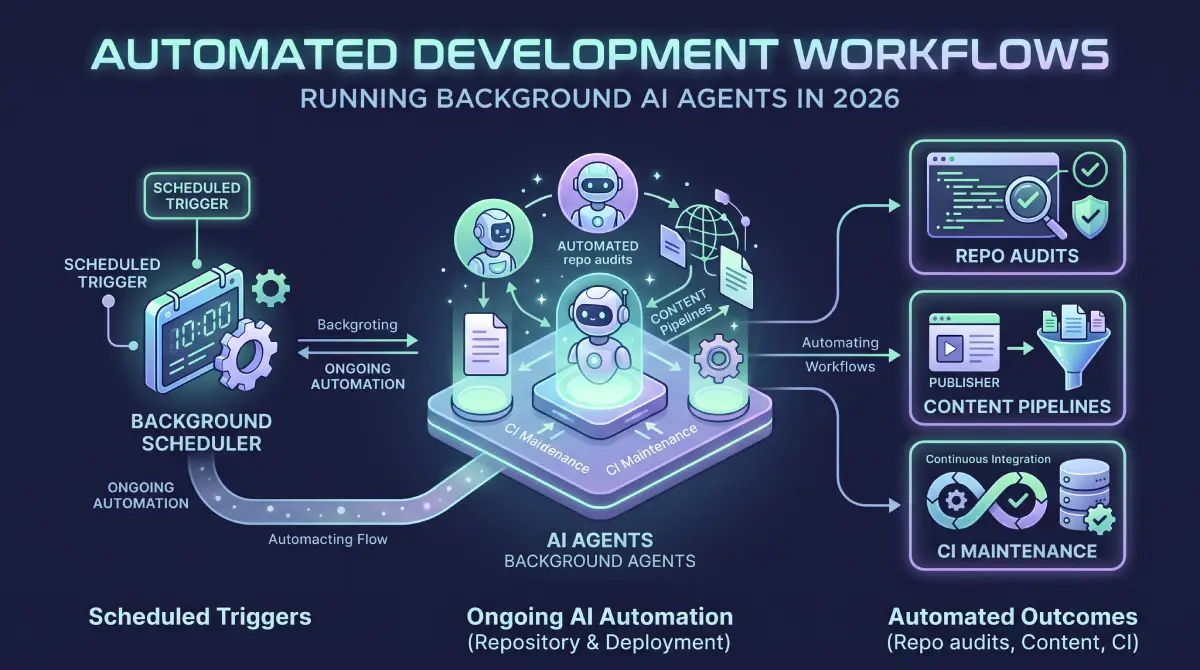
Modern software development has evolved from reactive coding to continuous, autonomous assistance. In 2026, background AI agents act as asynchronous teammates—monitoring dependencies, auditing repository health, drafting technical posts, and keeping documentation in sync without requiring real-time human intervention.
Setting up reliable background automations requires moving beyond ad-hoc scripts to structured, permission-controlled agent workflows.
TL;DR
- Asynchronous Execution: Background automations shift routine maintenance and scheduled content updates out of the active developer loop.
- Granular Permissions: Sandboxing, least-privilege command access, and pre-verified tool authorizations prevent unattended runs from failing or executing risky actions.
- Standardized Environments: Scheduled agents operate on clean, isolated sessions with explicit context, making self-contained prompts essential.
- Human-in-the-Loop Review: Pairing automated background tasks with branch-based workflows or pull requests ensures reviewability before hitting production.
1. Why Background Automations Matter in 2026
Engineering teams spend significant time each week on recurring tasks:
- Tracking breaking changes in dependencies and updating lockfiles.
- Running routine security checks and code deprecation audits.
- Generating draft summaries and changelogs from merged commits.
- Keeping portfolio blogs and documentation sites current with new developments.
When these operations are turned into scheduled background automations, developers define the task rules once and let autonomous workflows execute on a predictable schedule (hourly, daily, or weekly).
2. Key Principles for Autonomous Agent Workflows
1. Self-Contained Prompts
Because scheduled runs trigger in fresh conversation environments without shared conversational memory, each prompt must contain:
- The target repository or workspace path.
- Exact guidelines on expected output formats (e.g., frontmatter structure for MDX posts).
- Verification steps (such as running linters or typechecks before committing).
2. Least-Privilege Execution
Unattended agent execution requires deterministic security boundaries:
- Explicit command scoping (e.g., granting
command(git commit)andcommand(git push)without blanket shell execution). - Scoped workspace paths rather than broad filesystem permissions.
- Pre-authorized credentials so processes don't stall waiting for user approval.
3. Clear Verification & Git Hygiene
Every background automation should follow clean git hygiene:
- Inspect existing patterns and conventions before adding files.
- Verify changes cleanly without dirtying unrelated files.
- Commit with concise, descriptive commit messages.
3. Looking Ahead
As agent protocols continue to mature, scheduled background tasks will become the default way developers maintain codebases, run automated migrations, and manage developer portfolios effortlessly.