Local-First Architecture in 2026: The End of Spinners and Fragile CRUD
 Derar SattoufWeb Architecture
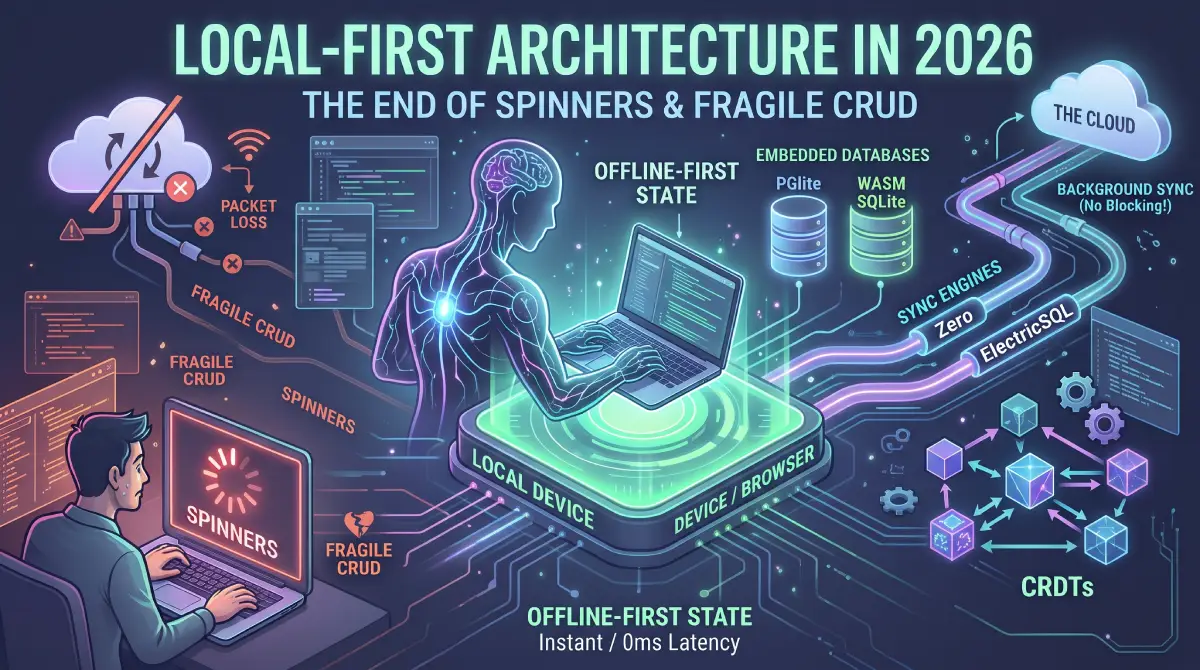
Local-First Architecture in 2026: The End of Spinners and Fragile CRUD
For more than two decades, web application architecture has operated on an unspoken compromise: the client is essentially an empty terminal, and the server is the single source of truth. Every user interaction—clicking a toggle, submitting a comment, moving a card in a Kanban board—triggers an HTTP request across the internet.
To hide network latency, frontend teams invented increasingly elaborate illusions: optimistic UI updates, skeleton loaders, debounce hooks, and complex cache invalidation rules in React Query or SWR. Yet the fundamental fragility remains. Step into an elevator, lose cell coverage on a train, or experience a 500ms server hiccup, and the user interface stutters or fails completely.
In 2026, the industry is undergoing its most significant frontend architectural shift since the single-page application: Local-First Architecture.
Instead of treating the client as a thin view layer that queries a remote database, local-first applications flip the model. The client owns and operates its own embedded, fully transactional database. Reads and writes execute locally in sub-millisecond time. Background synchronization engines silently replicate changes to the cloud and other clients when connectivity exists.
This guide breaks down how local-first web systems operate in production, the mature 2026 technology stack (from PGlite to Zero and ElectricSQL), conflict resolution strategies, and how to adopt this architecture in modern full-stack frameworks.
TL;DR
- Zero Perceived Latency: Local-first apps read from and write directly to an in-browser database (WASM SQLite, OPFS, or PGlite). Operations complete in less than 1 millisecond regardless of network speed.
- Offline Is a Natural State, Not an Error: Because the local database is the primary source of truth, offline support is not a bolted-on feature; it is the default operational mode.
- Sync Engines Replace REST/GraphQL APIs: Instead of writing dozens of custom CRUD endpoints, frontend queries synchronize authorized slices of data via bidirectional sync protocols (Zero, ElectricSQL, PowerSync).
- Conflict Resolution Without Headaches: Deterministic Last-Write-Wins (LWW) with Lamport timestamps handles standard records; Conflict-Free Replicated Data Types (CRDTs) like Yjs or Automerge handle collaborative rich text and complex collections.
- Distributed Systems Complexity Shifts to the Client: The trade-off is architectural complexity: client-side schema migrations, row-level synchronization security, and storage quota management must be handled with care.
1. Cloud-First vs. Local-First: The Paradigm Shift
To appreciate why local-first feels so radically responsive, contrast the traditional cloud-first request-response loop with a local-first pipeline:
[Traditional Cloud-First Loop]
User Action ──> Optimistic UI (fake) ──> Network Request (100-800ms)
                     │                              │
                     ▼                              ▼
             Revert if failed                Remote DB Write
                     ▲                              │
                     └──────── Network Response ────┘

[Local-First Architecture]
User Action ──> Local In-Memory/WASM DB Write (<1ms) ──> UI Reactive Render (instant)
                                   │
                                   ▼
                      Async Background Sync Protocol
                                   │
                                   ▼
                   Central Cloud Database (Postgres)
In the cloud-first model:
- The network is in the critical rendering path.
- State management libraries spend 40% of their complexity juggling loading states, error boundaries, retry loops, and cache invalidation keys (
queryClient.invalidateQueries()). - Data consistency across tabs or simultaneous user edits requires manual WebSocket plumbing.
In the local-first model:
- The network is completely removed from the user interaction loop.
- The UI binds reactively to local database tables or query subscriptions. When data updates in the local database, the UI updates instantly.
- The network is exclusively an asynchronous synchronization transport.
2. The 2026 Local-First Technology Stack
Building local-first applications used to require writing custom IndexedDB sync layers from scratch. In 2026, a robust ecosystem of production-grade primitives exists:
1. In-Browser Storage: OPFS and WASM Engines
The foundational enabler of modern local-first web apps is the Origin Private File System (OPFS). Unlike traditional IndexedDB, which suffered from slow transaction serialization and inconsistent browser implementations, OPFS provides a fast, sandboxed, byte-level filesystem accessible by Web Workers.
- SQLite over OPFS: Compiling SQLite to WebAssembly running against OPFS yields raw read/write speeds exceeding tens of thousands of operations per second inside the browser.
- PGlite (Postgres in WASM): Created by ElectricSQL, PGlite packages the official PostgreSQL engine into a lightweight WASM binary (~3MB compressed). It runs full Postgres SQL queries—including JSONB operators, CTEs, and full-text search—directly inside the client browser thread or Web Worker without needing an external daemon.
2. Synchronization Engines
A sync engine sits between the client database and the cloud database, managing change tracking, authorization, and replication.
┌─────────────────────────────────┐
│     Client (Browser/Mobile)     │
│  ┌───────────┐   ┌───────────┐  │
│  │ React UI  │<──│ Local DB  │  │
│  └───────────┘   └─────┬─────┘  │
└────────────────────────┼────────┘
                         │ Replication Protocol
                         ▼
┌─────────────────────────────────┐
│     Sync Engine (Relay/Auth)    │
│  - Row-Level Access Filters     │
│  - Change Data Capture (CDC)    │
└────────────────────────┼────────┘
                         │ Logical Replication
                         ▼
┌─────────────────────────────────┐
│   Central Postgres Database     │
└─────────────────────────────────┘
The leading sync layers in 2026 include:
- Zero (by Rocicorp): A declarative, relational sync engine designed for TypeScript applications. You define schema shapes and sync queries; Zero automatically streams only the rows the user is permitted to see into an in-memory client cache, keeping it updated in real time.
- ElectricSQL: Uses PostgreSQL Logical Replication (Change Data Capture / CDC) to stream subsets of your central Postgres database directly into client-side SQLite or PGlite instances.
- PowerSync: A battle-tested offline-first sync layer connecting client SQLite databases to central backends like Postgres, MySQL, or Supabase, with granular sync rules defined in SQL.
3. Conflict Resolution: LWW and CRDTs
When multiple clients modify data while offline, conflicts inevitably occur upon reconnection. 2026 applications divide data into two categories:
- Standard Entities (Last-Write-Wins with Timestamps): For typical form fields (e.g., updating a user's display name or status), assigning hybrid logical clocks or server-sequenced transaction IDs is sufficient. The most recent valid write wins.
- Collaborative Structures (CRDTs): For rich text, document trees, canvases, or shared lists, Conflict-Free Replicated Data Types (implemented via libraries like
YjsorAutomerge) guarantee that all concurrent edits converge deterministically to the identical state without human intervention or data loss.
3. Code Example: Building a Reactive Local-First Store
Here is how a real local-first data access layer looks in a modern Next.js/React component using a declarative client sync layer:
// lib/db/schema.ts
import { createTable, string, boolean, number } from "@rocicorp/zero";

export const taskTable = createTable("tasks", {
  id: string(),
  title: string(),
  completed: boolean(),
  priority: number(),
  updatedAt: number(),
  workspaceId: string(),
});

// components/task-list.tsx
"use client";

import { useZero, useQuery } from "@/lib/db/provider";
import { taskTable } from "@/lib/db/schema";

export function TaskList({ workspaceId }: { workspaceId: string }) {
  const z = useZero();

  // Reactive query subscription directly against the client database.
  // This query never hits the network; it executes against the local WASM store.
  const [tasks] = useQuery(
    z.query.tasks
      .where("workspaceId", "=", workspaceId)
      .orderBy("priority", "asc")
  );

  const toggleTask = (taskId: string, currentCompleted: boolean) => {
    // Local mutation: writes instantly to local store, UI re-renders in <1ms.
    // The sync engine automatically queues and replicates the change to Postgres.
    z.mutate.tasks.update({
      id: taskId,
      completed: !currentCompleted,
      updatedAt: Date.now(),
    });
  };

  const addTask = (title: string) => {
    z.mutate.tasks.insert({
      id: crypto.randomUUID(),
      title,
      completed: false,
      priority: tasks.length + 1,
      updatedAt: Date.now(),
      workspaceId,
    });
  };

  return (
    <div className="space-y-3">
      {tasks.map((task) => (
        <div key={task.id} className="flex items-center gap-3">
          <input
            type="checkbox"
            checked={task.completed}
            onChange={() => toggleTask(task.id, task.completed)}
            className="size-4"
          />
          <span className={task.completed ? "line-through text-muted" : ""}>
            {task.title}
          </span>
        </div>
      ))}
    </div>
  );
}
Notice what is missing from this code:
- No
isLoadingspinners. - No
try/catchblocks wrapping simple UI toggles. - No
useEffectfetching logic. - No optimistic UI rollback handlers.
The code assumes data is always present locally and operations are instantaneous.
4. Architectural Challenges & Production Realities
While local-first unlocks incredible user experiences, it introduces real distributed-systems challenges that frontend engineers must prepare for:
1. Client-Side Schema Migrations
In a traditional web app, running a database migration is a single centralized operation: you run prisma migrate deploy or drizzle-kit push in CI/CD against Postgres.
In a local-first application, there are thousands of client databases distributed across laptops, smartphones, and tablets, running various versions of your software.
- You must write backwards-compatible migrations.
- When a user opens an offline tab after six months, the client database must cleanly upgrade its local schema through progressive migration scripts before executing sync protocols.
2. Authorization and Partial Replication
You cannot replicate an entire 50GB PostgreSQL database to a user's phone.
- The sync engine must enforce strict Shape Scoping or Row-Level Security (RLS).
- A user must only synchronize data belonging to their active workspaces or tenants.
- Access tokens must be verified before changes stream to the client.
3. Storage Quotas and Eviction Policies
Mobile browsers have strict storage quotas (often 1GB to 2GB per origin depending on available disk space).
- Applications must define clear eviction strategies for historical records (e.g., retaining the last 90 days of activity locally while archiving older records in cloud cold storage).
- Handle browser storage eviction warnings gracefully by requesting persistent storage permissions (
navigator.storage.persist()).
5. When to Choose Local-First (and When to Avoid It)
Local-first is not a silver bullet for every web project. Use this decision matrix:
| Application Type | Recommendation | Why | | :----------------------------------------------- | :------------- | :------------------------------------------------------------------------------------------------------------- | | Productivity Tools (Notes, Docs, Tasks) | Strong Yes | Users demand instantaneous responsiveness, offline editing, and frictionless multi-device synchronization. | | Creative Tools (Canvases, Design, Audio) | Strong Yes | Heavy state changes and high-frequency interactions require zero-latency local execution. | | B2B SaaS / Workspaces (Linear, Notion style) | Strong Yes | Power users spend entire workdays in the tool; eliminating loading spinners drives high customer retention. | | E-Commerce & Ticket Booking | No | Requires centralized, strict single-source-of-truth inventory locks (preventing double-selling concert seats). | | Financial Ledgers & Banking | No | Centralized audit trails and strict atomic transactions must settle in authoritative cloud ledgers. | | Public Social Media / Massive Feeds | Hybrid | Read public global feeds from edge CDNs; store user drafts, bookmarks, and private chats local-first. |
6. Looking Forward
The trajectory of software engineering has always oscillated between centralized mainframes and powerful client workstations. The cloud era centralized everything into distant server farms; the local-first era brings computation back to where the user is, using the cloud for what it is best at: synchronization, durable backup, and global discovery.
By deploying embedded databases directly into user runtimes, frontend engineers can finally banish loading spinners, defeat network latency, and build web applications that feel as permanent and responsive as native desktop software.