The Rust Toolchain Takeover: Rolldown, Biome, and Turbopack in 2026
 Derar SattoufTooling
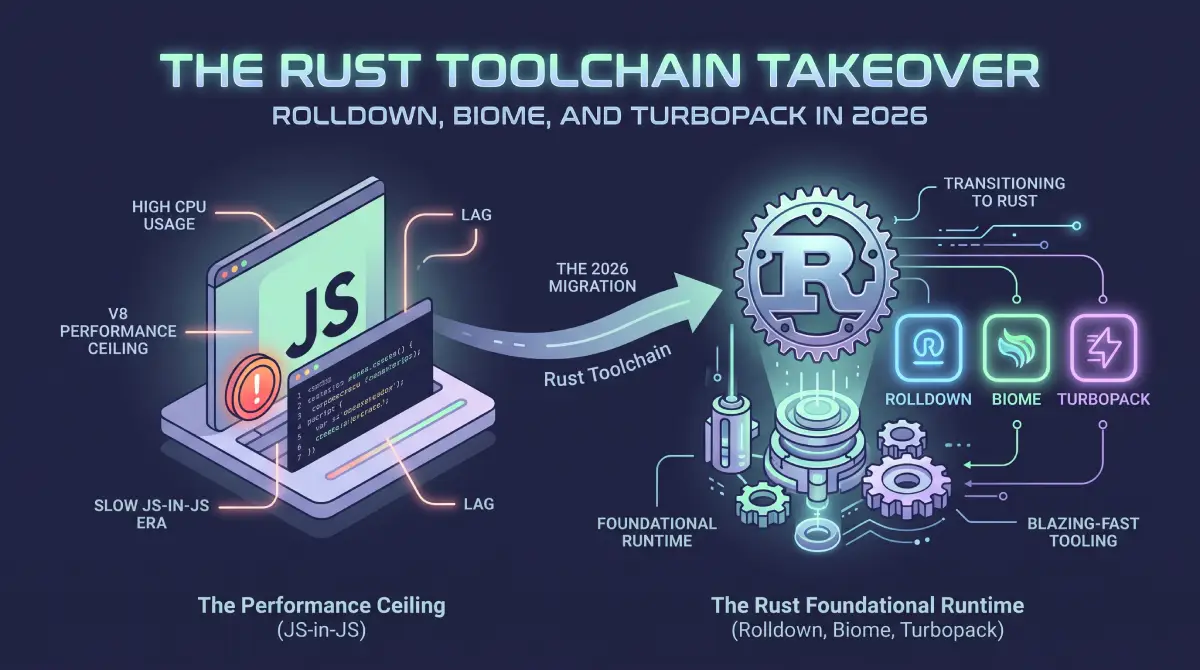
The Rust Toolchain Takeover: Rolldown, Biome, and Turbopack in 2026
For over a decade, the JavaScript ecosystem operated on an elegant, self-referential dogma: JavaScript tooling should be written in JavaScript.
Webpack, Babel, ESLint, Prettier, and Rollup were all conceived in Node.js. That philosophy had obvious virtues: any frontend engineer who consumed the tool could also debug it, contribute plugins, and patch its AST transforms. But as enterprise web applications scaled into millions of lines across giant monorepos, the physical limits of the V8 engine began to show.
In huge projects, developers spent ten minutes waiting for cold builds, twenty seconds on incremental hot-module reloads, and minutes waiting for ESLint and Prettier to parse the same abstract syntax trees repeatedly in CI.
In 2026, the transition is essentially complete. The core infrastructure of web development has been rewritten in Rust.
With the stabilization of Rolldown in the Vite ecosystem, the widespread enterprise adoption of Biome (replacing both ESLint and Prettier), the maturation of Turbopack in Next.js, and the speed of Oxc (The Oxford Compiler), frontend engineering is experiencing an order-of-magnitude leap in build velocity.
This post explores the architectural mechanics behind why Rust conquered the JavaScript toolchain, how memory layouts and zero-cost abstractions defeat V8, and how engineering teams should structure their migration.
TL;DR
- The JS-in-JS Era Hit the Wall: V8 is exceptionally fast for dynamic execution, but garbage collection overhead, memory fragmentation, and single-threaded event loop bottlenecks prevent it from scaling to multi-million line builds.
- The Modern Rust Toolchain:
- Rolldown: Vite's Rust-based bundler providing 100% Rollup plugin compatibility at 10x-30x the speed.
- Biome: A single, unified Rust tool that lints, formats, and analyzes code in milliseconds, replacing fragile ESLint/Prettier combinations.
- Oxc: An ultra-fast JavaScript/TypeScript toolsuite powering AST parsing, minification, and semantic linting.
- Turbopack: Vercel’s incremental Rust bundler integrated into the Next.js production pipeline.
- Why Rust Wins on Hardware: Contiguous memory layouts, arena/bump allocation, true multi-threaded CPU saturation via Rayon, and zero garbage collection pauses.
- The Extensibility Compromise: Writing plugins in native Rust is harder than writing JavaScript functions. The ecosystem has solved this via NAPI-RS bindings and WASM plugin runtimes.
1. Why JavaScript Hit the V8 Performance Ceiling
To understand why rewrites in Rust were necessary, one must look at how JavaScript handles AST (Abstract Syntax Tree) processing:
[Traditional JS Tooling (ESLint + Webpack)]
Source Files ──> Parse to V8 Heap AST (Huge JSON-like objects)
                       │
                       ▼
          Iterate AST in Single Thread ──> GC Pauses & Cache Misses
                       │
                       ▼
          Pass AST to Linter / Bundler ──> Re-parse or serialize IPC
When Webpack or ESLint parses a TypeScript file:
- Object Allocation Explosion: Every AST node (identifier, statement, binary expression) becomes an individual JavaScript object on the V8 heap. A 5,000-line file can produce hundreds of thousands of heap objects.
- Cache-Unfriendly Pointer Chasing: Because JavaScript objects are scattered unpredictably across heap memory, the CPU cache (L1/L2/L3) suffers constant cache misses while walking the tree.
- Garbage Collection Pressure: When a compilation step completes, V8’s garbage collector must traverse and deallocate millions of orphaned AST nodes, causing noticeable "stop-the-world" pauses.
- The Multithreading Tax: Node.js runs on a single main thread. To use multiple CPU cores, tools like Webpack or Jest must spin up separate Worker threads, serializing AST objects across
postMessageboundaries—an overhead that often cancels out parallel speedups.
2. The Mechanics of Rust's Performance Supremacy
Rust is not just "faster C++ with a compiler." It provides specific architectural primitives that are uniquely suited for language parsers, compilers, and bundlers:
┌─────────────────────────────────────────────────────────────┐
│                 Rust Tooling Architecture                   │
├───────────────────────────────┬─────────────────────────────┤
│ 1. Arena Allocation (Bumpalo) │ Allocates AST in contiguous │
│                               │ memory blocks. Deallocates  │
│                               │ entire tree in 1 cycle.     │
├───────────────────────────────┼─────────────────────────────┤
│ 2. Data Parallelism (Rayon)   │ Work-stealing thread pools  │
│                               │ saturate all CPU cores with │
│                               │ zero IPC serialization tax. │
├───────────────────────────────┼─────────────────────────────┤
│ 3. Flat Cache-Friendly Memory │ Structs packed tight for L1 │
│                               │ and L2 hardware cache hits. │
└───────────────────────────────┴─────────────────────────────┘
1. Arena Allocation (bumpalo)
Instead of allocating every AST node individually on a general-purpose heap, Rust compilers use Arena Allocators.
- Memory for thousands of AST nodes is reserved in a single contiguous chunk.
- Allocating a node is as cheap as bumping an integer pointer.
- When the file transform finishes, the entire arena is dropped in one CPU instruction, eliminating GC cycles entirely.
2. Painless Thread Parallelism (rayon)
In Rust, libraries like rayon allow compilers to parallelize file analysis across every available CPU core with minimal syntax:
// Processing 5,000 source files in parallel across all CPU cores
use rayon::prelude::*;

let results: Vec<ParsedModule> = files
    .par_iter()
    .map(|file| parse_and_transform(file))
    .collect();
Because Rust’s type system enforces thread safety at compile time (Send and Sync), there are no race conditions, shared memory corruption, or Node.js IPC serialization costs.
3. The 2026 Core Players
The modern Rust frontend landscape has coalesced around four key technologies:
1. Rolldown: Vite's Secret Weapon
For years, Vite used a dual architecture: esbuild (written in Go) for fast local development, and Rollup (written in JavaScript) for production bundling. This created a dual-engine problem: plugins had to be tested against two different bundlers, and certain dev-prod discrepancies were difficult to eliminate.
Rolldown was created to unify this. It is a Rust-based bundler designed as a drop-in replacement for Rollup. It matches Rollup's API and plugin hooks while delivering the raw speed of native code. In 2026, Vite natively delegates bundling to Rolldown, cutting production build times by 80% to 90%.
2. Biome: Unifying Linting and Formatting
For years, standard JavaScript repos suffered through the "ESLint + Prettier" configuration tax:
- Installing dozens of plugins:
eslint-plugin-react,eslint-plugin-import,@typescript-eslint/parser,prettier-plugin-tailwindcss. - Resolving rule collisions between Prettier's formatting and ESLint's stylistic rules.
- Running two separate tools in CI that both had to parse the exact same codebase twice.
Biome (originally spearheaded by the Rome project) solves this by bundling formatter, linter, and import organizer into a single native binary.
- It formats and lints 100,000 lines of code in under 150 milliseconds.
- It has near-zero configuration overhead: a single
biome.jsonfile. - It provides a built-in migration command (
biome migrate) that reads existing.eslintrcand.prettierrcfiles and translates them automatically.
3. Oxc (The Oxford Compiler)
Headed by Boshen, Oxc is designed to be the fastest JavaScript toolsuite on earth. Its AST parser and semantic analyzer outperform SWC and Babel by margins of 2x to 5x. Major projects, including Rolldown and enterprise monorepo orchestrators, leverage Oxc under the hood for AST parsing and semantic resolution.
4. Turbopack: Incremental Monorepos
Integrated into Next.js, Turbopack leverages an incremental computational graph engine. It remembers every function call and dependency relationship. When you edit a component, it only recomputes the exact dependency leaf affected, rather than re-evaluating parent trees.
4. Benchmark Snapshot: 2026 Enterprise Monorepo
To understand what this looks like in numbers, consider a benchmark across a 250,000-line TypeScript enterprise monorepo:
| Operation | Legacy JS Stack (Webpack + ESLint + Prettier) | Modern Rust Stack (Turbopack/Rolldown + Biome) | Speedup Factor | | :------------------------------- | :-------------------------------------------- | :--------------------------------------------- | :------------------------ | | Cold Production Build | 4 minutes 12 seconds | 18 seconds | ~14x faster | | Full Workspace Lint & Format | 1 minute 45 seconds | 1.8 seconds | ~58x faster | | Hot Module Reload (HMR) | 850 ms | 18 ms | ~47x faster (Instant) | | CI Static Analysis Gate | 3 minutes 20 seconds | 6.5 seconds | ~30x faster |
The real business impact of this speedup is not just developer happiness; it is CI throughput. Pull request checks that previously clogged GitHub Actions queues for 15 minutes now report status in seconds, unlocking true continuous delivery.
5. Migrating Your Repo: A Practical Strategy
If your team is currently maintaining a complex Webpack/Rollup, ESLint, and Prettier configuration, here is the recommended phased adoption plan:
Phase 1: Migrate Formatting and Linting to Biome
This is the lowest-risk, highest-yield migration.
# 1. Install Biome
pnpm add -D --save-exact @biomejs/biome

# 2. Initialize configuration
pnpm biome init

# 3. Test format and linting
pnpm biome check --write ./src
Replace your package scripts:
// package.json
{
  "scripts": {
    "lint": "biome check ./src",
    "format": "biome format --write ./src"
  }
}
You can safely remove dozens of ESLint packages and plugins from devDependencies, shrinking node_modules instantly.
Phase 2: Enable Turbopack or Rolldown in Development
For Next.js applications, ensure you are running the native Turbopack dev server:
next dev --turboFor Vite projects, enable the Rolldown-backed build pipeline according to the current Vite documentation.
6. The Real Trade-offs: What Did We Give Up?
The transition to Rust is not without genuine engineering costs:
- The Plugin Authoring Bar: In the Webpack era, an engineer could write an ad-hoc AST plugin in 20 lines of JavaScript. Writing a custom Rust plugin requires understanding Rust's ownership model, lifetime semantics, and setting up cargo toolchains.
- Binary Distribution Complexity: Rust tools must compile to native machine binaries for macOS (x64 and Apple Silicon), Linux (x64, ARM, musl), and Windows. While tools like
NAPI-RSand prebuilt npm distribution wrappers make this transparent to consumers, maintaining native binary releases is harder for package authors. - WASM Fallbacks: In environments where native binary execution is restricted (such as locked-down corporate sandboxes or in-browser IDEs), running tools compiled to WASM introduces a 2x-3x performance penalty compared to native machine code (though still significantly faster than pure JS).
7. The Outlook
The debate over whether developer tooling should be written in JavaScript or native languages is over. Rust has established itself as the bedrock runtime for web development infrastructure.
By stripping away the memory fragmentation and GC overhead of the V8 engine, modern Rust tooling lets engineers spend their computing power on building rich features and validating code correctness rather than watching terminal loading spinners.