Real-Time AI Streaming in 2026: SSE, WebSockets, and WebTransport Compared
 Derar SattoufWeb Architecture
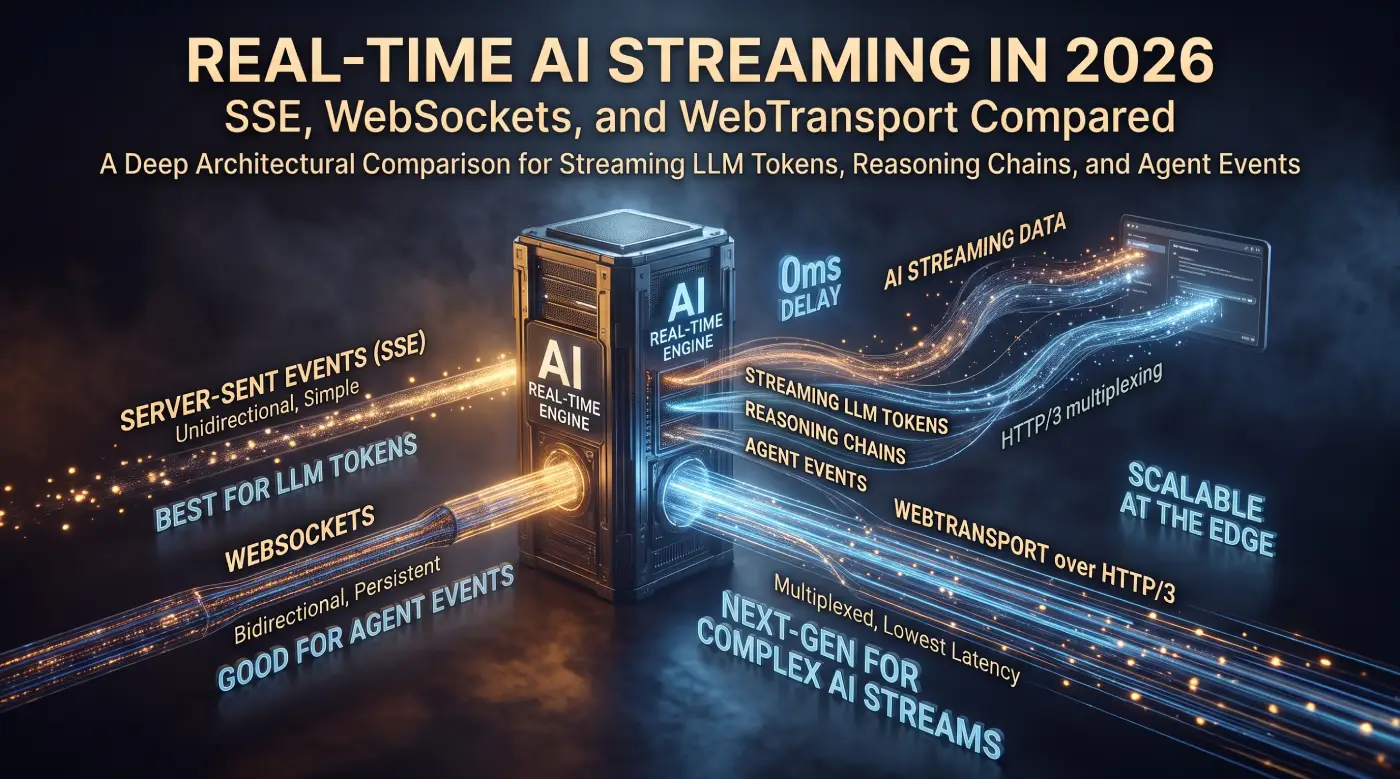
Real-Time AI Streaming in 2026: SSE, WebSockets, and WebTransport Compared
In 2024, streaming an AI response was primarily a gimmick to make chatbot interfaces feel responsive while an LLM generated text. In 2026, streaming is the foundational transport layer of AI applications.
Modern AI workflows stream much more than raw text chunks:
- Multi-phase reasoning tokens ("thinking" or chain-of-thought traces).
- Structured JSON tool-call invocations and client confirmations.
- Real-time agent status feeds, subagent lifecycle events, and canvas diffs.
- Low-latency bidirectional audio and vision streams for voice agents.
Yet engineering teams frequently struggle with transport protocol selection: Should we use Server-Sent Events (SSE)? Are WebSockets better for multi-agent interactions? When does WebTransport over HTTP/3 justify its complexity?
Choosing the wrong protocol leads to buffer starvation, edge-proxy buffering, connection exhaustion, or firewall drops. This guide provides a definitive comparison of SSE, WebSockets, and WebTransport for modern AI systems, with concrete architecture patterns, benchmarks, and production edge cases.
TL;DR
- Server-Sent Events (SSE) remains the gold standard for text and agent tokens: Unidirectional, HTTP/2 multiplexed, natively supported by browser
EventSourceandfetchstreams, and zero-headache traversal through corporate firewalls and CDNs. - WebSockets are for bidirectional, conversational audio/state: When the client must continuously stream mic audio, camera frames, or user interruptions back to the server in real time with low latency.
- WebTransport (over HTTP/3 & QUIC) is the future of high-throughput multimodal agents: True multiplexing without TCP head-of-line blocking, connection migration across Wi-Fi and 5G cellular switches, and support for both reliable streams and unreliable datagrams.
- The Biggest Production Trap: Proxy Buffering: Nginx, Cloudflare, and corporate forward proxies will buffer chunked transfers unless explicit
X-Accel-Buffering: noandCache-Control: no-transformheaders are set.
1. The Protocol Landscape at a Glance
Before examining deep mechanics, here is how the three protocols compare across key engineering dimensions:
| Dimension | Server-Sent Events (SSE) | WebSockets (WS) | WebTransport (WT) |
| :----------------------------- | :------------------------------------------- | :----------------------------------- | :------------------------------------------- |
| Transport Layer | HTTP/1.1 or HTTP/2 over TCP | HTTP Upgrade to raw TCP | HTTP/3 over QUIC (UDP) |
| Directionality | Unidirectional (Server $\rightarrow$ Client) | Bidirectional (Full Duplex) | Bidirectional (Full Duplex) |
| Head-of-Line Blocking | Present per HTTP/2 TCP stream | Present on single TCP socket | Eliminated (Independent Streams) |
| Reconnection Handling | Built-in browser auto-reconnect | Manual heartbeat & backoff | Manual connection logic |
| Firewall / Proxy Traversal | Trivial (Standard HTTP GET) | Moderate (Requires Upgrade proxying) | Improving (Requires UDP / QUIC support) |
| Framing Format | Plain UTF-8 text (text/event-stream) | Binary or Text frames | Binary or Text streams & datagrams |
| Connection Multiplexing | Native (Shares single HTTP/2 TCP conn) | None (1 TCP socket per connection) | Native (Unlimited streams per QUIC conn) |
| Primary AI Use Case | LLM text, thinking tokens, tool calls | Voice agents, audio streaming | Multimodal agents, video streaming |
2. Server-Sent Events (SSE): The Lightweight Champion
For 85% of AI applications, Server-Sent Events is the optimal architectural choice.
How SSE Operates
SSE uses a standard HTTP GET request with the Accept: text/event-stream header. The server holds the response open indefinitely, streaming plain text lines structured with simple prefixes:
HTTP/1.1 200 OK
Content-Type: text/event-stream
Cache-Control: no-cache, no-transform
Connection: keep-alive
X-Accel-Buffering: no

event: reasoning
data: {"step": "searching_database", "query": "orders"}

event: token
data: {"text": "Found 3 matching orders"}

event: done
data: {}
Why SSE Dominates AI Token Generation
- HTTP/2 Multiplexing: In HTTP/1.1, browsers imposed a strict limit of 6 concurrent connections per domain. In HTTP/2, dozens of independent SSE streams (multiple subagent runs, parallel tabs) share a single TCP connection, consuming negligible server socket resources.
- Native Resilience: If a mobile device switches towers and drops the connection, the browser's native
EventSourceautomatically reconnects and sends aLast-Event-IDheader, allowing the server to resume streaming from the exact dropped token without custom code. - Frictionless Auth & Edge Middleware: Because SSE requests are standard HTTP requests, they carry standard cookies,
Authorization: Bearerheaders, and integrate seamlessly with Next.js middleware, Vercel Edge Functions, and AWS CloudFront.
Code Example: Consuming Typed SSE in Next.js
// app/api/agent/stream/route.ts
export async function POST(req: Request) {
  const encoder = new TextEncoder();

  const stream = new ReadableStream({
    async start(controller) {
      const sendEvent = (event: string, data: unknown) => {
        controller.enqueue(
          encoder.encode(`event: ${event}\ndata: ${JSON.stringify(data)}\n\n`),
        );
      };

      sendEvent("status", { state: "thinking" });

      // Simulate token generation
      for (const word of ["Spec-Driven", " Development", " in", " 2026"]) {
        await new Promise((r) => setTimeout(r, 80));
        sendEvent("token", { delta: word });
      }

      sendEvent("done", { complete: true });
      controller.close();
    },
  });

  return new Response(stream, {
    headers: {
      "Content-Type": "text/event-stream",
      "Cache-Control": "no-cache, no-transform",
      Connection: "keep-alive",
      "X-Accel-Buffering": "no", // Crucial: disables Nginx / proxy buffering
    },
  });
}
3. WebSockets: When Full-Duplex Is Mandatory
Where SSE is strictly a one-way broadcast from server to client, WebSockets establish a persistent, bidirectional TCP connection.
When WebSockets Are Required for AI:
- User Voice Interruptions: In voice assistants (e.g., OpenAI Realtime API or custom WebRTC/WebSocket pipelines), the user continuously streams raw PCM audio chunks while the model streams synthesized audio chunks back. When the user speaks, an interrupt packet must reach the server in under 50ms to stop model playback immediately.
- Collaborative Multi-User Canvases: When multiple users and an AI agent collaborate on a shared canvas or document simultaneously, changes flow bidirectionally with sub-millisecond coordination.
The Hidden Operational Taxes of WebSockets:
- No HTTP/2 Multiplexing: Every active WebSocket tab consumes a dedicated TCP connection on your server or edge gateway. Ten thousand idle tabs equal ten thousand open TCP sockets.
- Load Balancer Stickiness: Routing WebSocket traffic requires sticky sessions or a centralized coordination layer (like Redis Pub/Sub or Dragonfly) to route messages across horizontally scaled backend servers.
- Corporate Proxy Hostility: Many enterprise firewalls and deep packet inspection proxies terminate or drop long-lived WebSocket connections after 60 seconds of inactivity.
4. WebTransport: The HTTP/3 & QUIC Frontier
WebTransport is the modern web API that leverages HTTP/3 over QUIC (UDP) to replace WebSockets and WebRTC data channels for next-generation interactive applications.
┌────────────────────────────────────────────────────────┐
│             WebTransport over HTTP/3 (QUIC)            │
├────────────────────────────────────────────────────────┤
│ 1. Unidirectional Streams   │ Fast server-to-client    │
│                             │ token & status feeds     │
├─────────────────────────────┼──────────────────────────┤
│ 2. Bidirectional Streams    │ Full-duplex audio, tool  │
│                             │ calls, interactive state │
├─────────────────────────────┼──────────────────────────┤
│ 3. Unreliable Datagrams     │ Loss-tolerant raw video  │
│                             │ and high-frequency mouse │
└─────────────────────────────┴──────────────────────────┘
The Superpowers of WebTransport:
- Zero Head-of-Line Blocking: In WebSockets or HTTP/2, if a single TCP packet is dropped by an unstable cellular connection, the entire connection stalls until that packet is retransmitted. In WebTransport, independent streams run over QUIC; a dropped packet in Stream A never stalls Stream B.
- Connection Migration: If a user walks out of their house and transitions from Wi-Fi to 5G cellular, their IP address changes. A WebSocket connection will drop and throw an error. A QUIC connection migrates seamlessly without renegotiating the handshake, keeping AI voice or video calls uninterrupted.
- Datagram Support: For real-time telemetry (such as cursor coordinates on an AI canvas or high-frequency webcam frames), WebTransport supports unreliable datagrams—dropping stale packets rather than holding up the pipeline.
When to Adopt WebTransport in 2026:
Adopt WebTransport if you are building multimodal AI voice/video agents or immersive spatial interfaces. For standard chat and text interfaces, SSE remains significantly simpler to deploy and debug.
5. Critical Production Traps & Fixes
Regardless of your chosen protocol, streaming AI responses introduces edge cases that traditional REST APIs never encountered:
Trap 1: Intermediate Proxy Buffering
By default, reverse proxies (Nginx, Envoy, Cloudflare, Traefik) optimize bandwidth by buffering responses until they reach 4KB or 8KB before flushing to the client. This turns a smooth, real-time typing animation into an ugly 3-second freeze followed by a sudden burst of text.
The Fix: Ensure your response headers explicitly disable proxy compression and buffering:
Cache-Control: no-cache, no-transform
X-Accel-Buffering: no
Content-Encoding: identity
Trap 2: Mobile Sleep Mode & Connection Dropping
Mobile browsers (Safari on iOS, Chrome on Android) throttle or suspend background tabs within 15 to 30 seconds of the user switching apps. When the user returns, the TCP connection is dead, but neither client nor server realized it.
The Fix: Implement a heartbeat event every 15 seconds:
: heartbeat\n\nLines starting with a colon : in SSE are treated as comments and ignored by parsers, but they keep the underlying connection alive and detect dropped sockets instantly.
Trap 3: Serverless Timeout Ceilings
Deploying streaming AI routes to serverless platforms (AWS Lambda, Vercel Serverless, Google Cloud Functions) can run into hard execution timeouts (e.g., 15s to 60s). If an AI agent executes multiple sequential tool calls that take 45 seconds total, the serverless container may terminate abruptly mid-stream.
The Fix:
- Use dedicated Edge Runtimes (which support streaming lifetimes up to several minutes).
- Decompose long-running tasks into asynchronous background jobs that post status updates to an in-memory Redis or local-first sync layer, rather than holding a single HTTP connection open for 5 minutes.
6. The Decision Framework
Use this simple heuristic to select your real-time protocol:
                      Need client-to-server streaming?
                                  │
                 ┌────────────────┴────────────────┐
                 ▼ NO                              ▼ YES
           Use SSE (HTTP/2)               Is it low-latency audio/video?
          (Text, code, tools)                      │
                                      ┌────────────┴────────────┐
                                      ▼ NO                      ▼ YES
                               Use WebSockets             Use WebTransport
                              (Chat + state)            (Voice, video, QUIC)
Conclusion
Streaming is no longer an optional frontend polish; it is the fundamental communication contract between users and AI systems.
For the vast majority of developer tools, code assistants, and knowledge applications, Server-Sent Events provides the ideal balance of simplicity, HTTP/2 multiplexing, and robust proxy traversal. As multimodal voice and vision workflows expand, WebTransport over HTTP/3 stands as the definitive high-throughput standard for the next generation of interactive software.