WebAssembly Component Model & WASI 0.2: Beyond Containers at the Edge
 Derar SattoufBackend
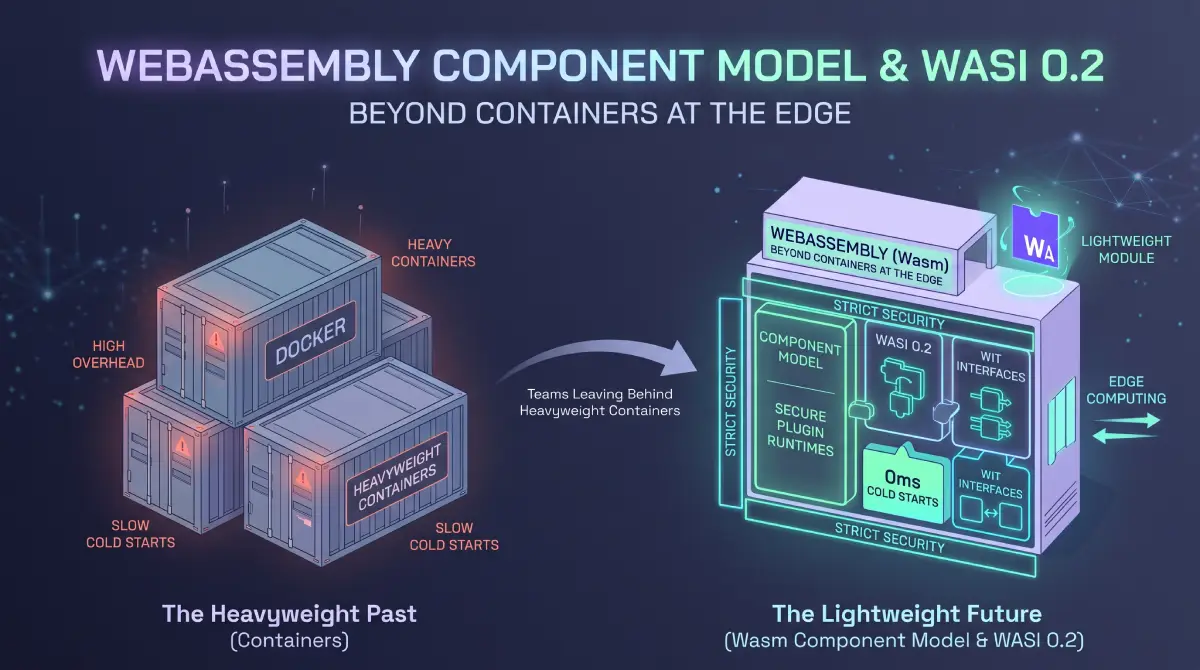
WebAssembly Component Model & WASI 0.2: Beyond Containers at the Edge
In 2019, Docker co-founder Solomon Hykes famously tweeted: "If WASM + WASI existed in 2008, we wouldn't have needed to have created Docker. That's how important it is."
For several years, that statement felt like distant hyperbole. WebAssembly was primarily viewed as a browser technology for running high-performance C++ games or running Figma's rendering engine in Chrome. Outside the browser, the WebAssembly System Interface (WASI) was nascent, lacking standardized socket networking, file I/O conventions, or a composable module system.
In 2026, the promise has arrived in full force.
With the stabilization of WASI 0.2 (WASI Preview 2) and the Wasm Component Model, WebAssembly has graduated from an experimental browser runtime into a powerful serverless, edge, and plugin compute architecture.
Engineering teams are no longer packaging every lightweight microservice, background utility, or user-defined script into a 400MB Linux container image. By using Wasm components, developers achieve sub-millisecond startup times, microsecond cold starts, true language interoperability, and capability-based security sandboxes that Docker was never designed to provide.
This post breaks down the technical mechanics of the Wasm Component Model, how WASI 0.2 functions in production, and how modern edge platforms leverage this shift.
TL;DR
- Microsecond Cold Starts: Unlike Linux containers that must initialize an entire user-space environment (taking 1 to 5 seconds), Wasm components instantiate in less than 1 millisecond, making them ideal for high-density edge serverless.
- The Wasm Component Model: Solves polyglot composition. Using WIT (Wasm Interface Type), a component written in Rust can directly call a component written in Go or Python with strict type safety, zero network overhead, and zero IPC serialization.
- Capability-Based Security by Default: A Wasm component starts with zero privileges. It cannot read the filesystem, access the network, or check system time unless the host runtime explicitly delegates that capability.
- Standardized Sockets & HTTP in WASI 0.2: WASI 0.2 introduces native HTTP proxying, streaming sockets, and standard clocks, eliminating the custom wrappers of earlier prototypes.
- The Ideal Use Cases: Edge middleware, serverless micro-functions, multi-tenant database extensions, and secure third-party plugin runtimes.
1. Why Containers Are Too Heavy for the Modern Edge
Docker containers fundamentally package a root filesystem alongside Linux kernel primitives (cgroups, namespaces, chroots). For full backend applications or complex monoliths, containers remain indispensable. But for micro-services, event-driven functions, and edge computing, containers carry structural inefficiencies:
[Docker Container Startup]
Download Image (50-500MB) ──> Mount Filesystem ──> Initialize Namespaces ──> Init Process (1-5s)

[Wasm Component Startup]
Download Bytecode (1-5MB) ──> JIT/AOT Compile into Sandbox ──> Execute Function (<1ms)- Massive Memory Footprint: Even a minimal alpine-based Node.js or Go container consumes 30MB to 100MB of resident memory just sitting idle. Running 1,000 independent customer tenants requires hundreds of gigabytes of RAM.
- Cold Start Penalties: When a serverless function spins down to zero, spinning it back up requires orchestrating container scheduling, networking bridges, and process boot sequences, causing noticeable multi-second latency spikes.
- Porous Multi-Tenant Isolation: Containers share the host Linux kernel. Vulnerabilities like kernel privilege escalations or container escape exploits mean hosting untrusted user-submitted code in standard Docker containers is a major security risk.
Wasm inverts these constraints. A WebAssembly binary is a hardware-agnostic compilation target that runs inside a tightly bounded virtual machine (such as wasmtime or v8). It uses megabytes of disk space and kilobytes of memory, instantiating in microseconds.
2. The Breakthrough: The Wasm Component Model & WIT
Until recently, WebAssembly modules suffered from a major limitation: they could only exchange basic primitive numbers (integers and floats) across module boundaries. Passing complex objects, strings, records, or arrays required tedious manual memory copying using pointer offsets in linear memory.
The Component Model completely resolves this using WIT (Wasm Interface Type).
WIT is a standardized, language-agnostic interface definition language. It allows developers to define types, records, variants, and functions that any language compiler can target.
┌────────────────────────────────────────────────────────┐
│                  Wasm Component Model                  │
├───────────────────────────────┬────────────────────────┤
│ Rust Component (Image Parser) │ Go Component (Auth)    │
├───────────────────────────────┴────────────────────────┤
│           Canonical ABI / WIT Type Contracts           │
├────────────────────────────────────────────────────────┤
│           Host Runtime (Wasmtime / Spin / V8)          │
│       - Capability Grants: HTTP, Filesystem, Clock     │
└────────────────────────────────────────────────────────┘
Writing a WIT Interface
Here is a sample analyzer.wit contract defining a text processing pipeline:
package local:analyzer;

interface text-tools {
    record AnalysisResult {
        word-count: u32,
        sentiment: float32,
        tokens: list<string>,
    }

    analyze: func(input: string) -> AnalysisResult;
}

world text-processor {
    export text-tools;
}
Implementing in Rust
When compiling Rust to a Wasm component, the wit-bindgen tool generates idiomatic, zero-overhead Rust structs:
// src/lib.rs
use bindings::exports::local::analyzer::text_tools::{AnalysisResult, Guest};

struct Component;

impl Guest for Component {
    fn analyze(input: String) -> AnalysisResult {
        let words: Vec<&str> = input.split_whitespace().collect();
        let word_count = words.len() as u32;

        AnalysisResult {
            word_count,
            sentiment: 0.85,
            tokens: words.iter().map(|w| w.to_string()).collect(),
        }
    }
}

bindings::export!(Component with_types_in bindings);
You compile this directly with cargo component build --release.
The resulting .wasm file can now be linked directly into a host application or combined with components written in Go, C, or Python. There is no network overhead, no HTTP serialization, and no IPC pipe. The host runtime enforces memory safety while passing complex types seamlessly.
3. What WASI 0.2 Delivers for Server Applications
The original WASI Preview 1 was essentially a minimal POSIX emulation. WASI 0.2 establishes a modular, capability-driven system contract specifically designed for cloud-native servers:
1. wasi-http
WASI 0.2 includes first-class support for HTTP clients and servers. A Wasm component can serve incoming HTTP requests directly, stream response bodies asynchronously, and make outbound sub-requests without relying on proprietary platform APIs.
2. wasi-clocks & wasi-random
Time and randomness are treated as explicit capabilities. If your component is a deterministic financial calculation engine, the host can revoke clock access, guaranteeing 100% reproducible execution runs without side channels.
3. Capability-Based Security
In a traditional Linux environment, any binary you execute inherits your user's permissions: it can read your SSH keys, open outbound network connections to unknown IP addresses, and write to temporary directories.
In WASI 0.2:
- A component has zero capabilities by default.
- If the component needs to query an external weather API, the host must explicitly grant an outbound HTTP socket scoped exclusively to that single domain.
- If it needs to log data, the host can grant read/write access to a single subdirectory (
/var/logs/app/), with no visibility into the parent filesystem.
4. Real-World Architectures: Where Wasm Wins in 2026
Modern infrastructure architectures deploy Wasm in four high-impact environments:
[Production Wasm Deployment Scenarios]
1. Edge Middleware           ──> Auth verification, bot mitigation, header rewriting (<1ms)
2. Safe Plugin Architectures ──> Executing user-authored code in SaaS products (Shopify/Figma)
3. Micro-Service Mesh        ──> Sub-millisecond polyglot functions without Kubernetes
4. Database User Functions   ──> Custom analytics running inside Postgres/ClickHouse safely
1. Zero-Trust Plugin Sandboxing
SaaS platforms (such as Shopify, Figma, Supabase, and Datadog) frequently need to let customers upload custom business logic or webhook processors.
- Running customer code in Docker containers requires expensive orchestration and introduces container breakout security risks.
- Running customer code in raw Node.js
vm2sandboxes has historically been plagued by security escapes. - Compiling customer scripts into Wasm components allows platforms to run thousands of untrusted tenant functions concurrently on a single server with hardware-enforced memory isolation.
2. Edge Middleware & Fast Routing
In edge networks (Cloudflare Workers, Fastly Compute, Fermyon Spin), incoming HTTP requests are intercepted by lightweight Wasm modules. Headers are sanitized, rate limits are checked in memory, and geolocation routing occurs before the request ever touches an origin server.
5. Docker Containers vs. Wasm Components: The Decision Matrix
Wasm is not a replacement for Docker in every scenario; it is a specialized execution paradigm that complements traditional infrastructure:
| Feature | Docker Containers | Wasm Components (WASI 0.2) | | :---------------------------- | :---------------------------------------------- | :-------------------------------------------------- | | Startup / Cold Start Time | 1 to 5 seconds | Sub-millisecond (< 1 ms) | | Artifact Size | 50 MB – 1 GB | 1 MB – 10 MB | | Memory Overhead | 30 MB – 150 MB per instance | < 2 MB per instance | | Security Isolation Model | OS-level namespaces (Shared Linux Kernel) | Capability-based VM isolation | | Ecosystem Maturity | Complete legacy software support | Ideal for greenfield & modern polyglot code | | Hardware Dependency | Bound to target architecture (x86/ARM) | Architecture-agnostic bytecode | | Best Suited For | Heavy monoliths, legacy databases, ML pipelines | Edge APIs, plugins, event handlers, micro-functions |
6. The 2026 Horizon
The evolution of cloud computing has been a steady march toward smaller units of compute: from physical dedicated servers, to virtual machines, to Docker containers, to serverless functions.
The WebAssembly Component Model and WASI 0.2 represent the logical next step in that progression. By stripping away operating system bloat and packaging software into lightweight, cryptographically isolated, instantly composable components, Wasm provides the foundation for the next decade of distributed, zero-trust cloud architecture.